Showing posts with label Mole. Show all posts

Monday, 10 August 2020

Tamales de mole amarillo

Mole amarillo is one of the most popular fillings for tamales, the best late-night treats available on the streets of Oaxaca, Mexico. This is my version created from the many different ones that I was shown and read about how to make. I use costeno amarillo chiles but unless you’ve got a stash that you picked up while in Oaxaca, you won’t have them. Substitute guajillos instead. The sauce will be a little more red/orange than yellowish in that case. There’s also some alternate vegetarian filling suggestions at the end.

These tamales are wrapped in banana leaves, which are available frozen in many Latin, Asian, and Indian grocery stores. I also use shortening rather than lard but if you are all about the lard, go ahead and use that for your masa. And if you don’t have comal, you can dry roast everything in a non-stick frying pan.

Makes 20-24 tamales

Ingredients:

Mole

4 chiles costeno amarillo
2 large plum tomatoes
½ small white onion, sliced
2 garlic cloves
2 med or 4 small tomatillos
2 cloves
Pinch of ground cinnamon
Pinch of cumin
1 ball of allspice
6 peppercorns
1 tsp oregano (preferably Mexican)
2 tbsp chopped fresh cilantro
1/3 cup masa harina
2 cups chicken stock (use the water you poached your chicken in)
2 tbsp olive oil
Salt to taste

Chicken for filling

8-10 chicken thighs
Handful of fresh parsley
1 clove of garlic
8 peppercorns
1 tsp salt

Masa for tamales

1 cup shortening
2 cups masa for tamales (store bought, dried)
1 tsp baking powder
1 tsp salt
1.5 cups warm chicken stock

1 pkg frozen banana leaves (defrosted)

Method:

  1. Poach the chicken: Put chicken into a pot with parsley, garlic, salt, and peppercorns. Cover with water and poach chicken until done. Save stock to use in making mole. Set chicken aside to cool.
  2. Remove stem and seeds from the chiles. Gently soften the chiles on the comal. Remove and place in a glass bowl and cover with boiling water. Let soak for at least 20 minutes.
  3. Dry roast onion slices, garlic in the skin, tomatoes, tomatillos on the comal.
    Once ready put them all in the blender (remember to cool and remove the skin from the garlic). Add the cilantro, oregano, and chiles with some of their soaking liquid. Waz until smooth, about 3-4 minutes.
  4. Grind the cloves, cumin, allspice, and pepper.
  5. Heat oil in a small pot and quickly fry spices, including cinnamon, when hot. Add chile mixture and sear.  Bring to the boil and stir for about 5 minutes. Add masa harina as well as ½ a cup or so of chicken stock. Let boil for about 10 minutes. Add more stock if it’s too thick and let boil for a total of 15-20 minutes. Add salt to taste.
  6. Shred the cooked chicken. Mix the shredded chicken and most of the mole together to make the tamale filling. It should be wet but not too runny. Add a little more of the mole and/or chicken broth until it is a good consistency.
  7. The package of masa you have should have instructions on how to make the dough, so it’s best to follow those.  Basically mix all the dry ingredients together in a bowl, then add the chicken stock and incorporate. It should create quite a damp (but not at all runny) dough. Beat the shortening in a stand mixer or with a hand mixer until it is quite fluffy, about 3-5 minutes. Then add the masa to the shortening and beat until mixed together, about another 2-3 minutes. You can test to see if it’s fluffy enough by putting a small ball into a glass of water. If it floats, you’re good to go!
  8. Put a layer of water about 5 cm/2” deep into a steamer pot or the largest pot you have in the house with a veg steamer tray in the bottom. The great thing about banana leaf tamales is you can just pile them one on top of another, unlike corn husk ones that need to be standing upright.
  9. Wipe down the leaves and trim them with a scissors: cut off the stem and make squares approx. 20 cm/8” (they don’t need to be perfect). You should also cut them with the grain of the leaf rather than against it. Either cut some thin strings from the banana leaf or use cooking twine for wrapping up the parcels. 
  10. Once your leaves are all prepared, pass them over a flame or grill, moving them constantly, until they soften and become pliable. The banana leaves have a white film on them. The heat should burn off the white film and make the leaves shinier. 
  11. Place ¼ cup of masa onto each banana leaf and flatten (this works best with a rubber spatula). Put about 2 tbsp of filling on to the top half of the masa (not in the middle). Fold the leaf so the lower part masa covers the filling.
    You may have to roll or fold it again to close the packet up tightish. Then fold the sides of the banana leaf one at a time to form a package. Tie with string and place folded side down into the pot on the steamer tray. Pile them up neatly around the pot as you go.
    Once you have all them all wrapped and ready, cover the pot and turn on the burner to get the water boiling. Once boiling, turn down to low and let your tamales steam for about 45 minutes.

  12. When done, remove from pot and let cool for about 10 minutes before serving. Top with a bit of salsa verde.


* Vegetarian fillings:

Oaxacan cheese and rajas (slices of jalapeno or roasted poblano)
Oaxacan cheese and refried beans


Sunday, 13 December 2015

Oaxacan mole amarillo


Now that I'm not travelling, I'm going to share some of the recipes that I learned or were inspired by my travels as well as any others that find their way out of my head since I love to cook and love to share. I welcome any and all feedback!

Costeno amarillo

In Oaxaca, I ate a lot of mole amarillo and absolutely fell in love with it. Like many of the traditional Oaxacan moles, it is made with chiles that can only be found in Oaxaca. In this case it’s chiles consteno amarillo. I brought back a whole bag of them and couldn’t wait to try it out. (Most recipes you can find on the internet will be made with guajillo, which just ain’t quite right!) While I ate a lot of this mole while there, it wasn’t one of the ones that I was shown how to make so this is a cobbling together of what I got from watching and tasting along the way.

My dad, who is a lover of both spicy food and Spanishy flavours has never really developed much enthusiasm for Mexican food. He envisions greasy, cheesy Tex-Mex and he’s just not interested. Not being one to give up when faced with Mexican food naysayers, I decided this dish could be the gateway to get him on board. And a good choice it was. While he did not go in with the most positive intent, he was won over by the smooth and distinctive flavour, which is not too spicy and relatively fruity as the chiles are sun dried and not smoky at all.

It is also one of the moles that is traditionally served with vegetables, in  this case chayote, potatoes, and green beans. This mole amarillo is also one of the most popular fillings for tamales, the best late-night treats available on the streets of Oaxaca.

4 servings

Mole
4 chiles costeno amarillo
2 large plum tomatoes
½ small white onion, sliced
2 garlic cloves
2 med or 4 small tomatillos
2 cloves
Pinch of ground cinnamon
Pinch of cumin
1 ball of allspice
6 peppercorns
1 tsp oregano (preferably Mexican)
2 tbsp chopped fresh cilantro
1/3 cup masa harina
1 litre of chicken stock
2 tbsp olive oil
Salt to taste

To poach chicken
8-10 chicken thighs
Handful of fresh parsley
1 clove of garlic
8 peppercorns
1 tsp salt

Vegetables
1 chayote
200 g of green beans
3 medium potatoes


Put chicken into a pot with parsley, garlic, salt, and peppercorns. Cover with water and poach chicken until done. Save stock to use in making mole. Set chicken aside.

Remove stem and seeds from the chile.

Gently soften the chiles on the comal. Remove and place in a glass bowl and cover with hot stock. Let soak for at least 20 minutes.

Dry roast onion slices, garlic in the skin, tomatoes, tomatillos on the comal. Once ready put them all in the blender (remember to cool and remove the skin from the garlic). Add the cilantro, oregano, and the chiles and soaking liquid.  Waz until smooth, about 3-4 minutes.

Grind the cloves, cumin, allspice, and pepper.

Heat oil in a pot and quickly fry spices when hot. Add chile mixture and sear.  Bring to the boil and stir for about 5 minutes. Add masa harina as well as ½ a cup or so of chicken stock. Let boil for about 10 minutes. Add more stock if it’s too thick and let boil for a total of 15-20 minutes. Add salt to taste.

In the meantime, peel and cut up the chayote. Cut up the potatoes into slightly larger pieces. Boil them in a mix of stock and water with a pinch of salt.  Clean and boil the beans in stock as well.

Mole amarillo
To serve: Two chicken thighs covered with one soup ladle + a bit of mole with a selection of the vegetables. Of course, fresh corn tortillas on the side are always welcome.

© Gail J. Cohen 2015


Saturday, 24 October 2015

The cooking show

First cooking class was today and I ended up being the only one in the class so it was essentially a private course and got to pick exactly what I wanted. Things started off brilliantly when I arrived and was offered coffee or chocolate. I had chocolate and it was brought to me steaming in a huge bowl with a side of sweet bread and hibuscus preserve. Dip that baby into the chocolate and you've arrived in heaven.

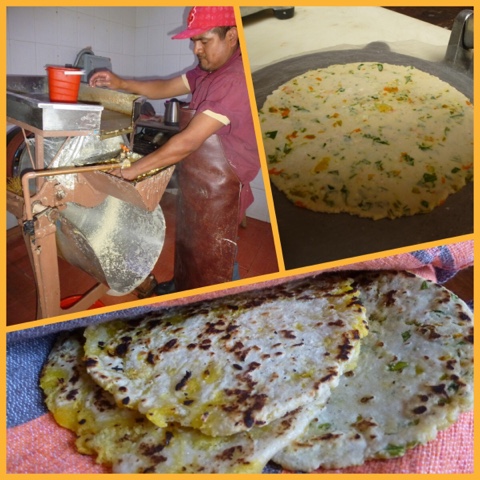
The class began with cleaning and preparing corn to make tortillas. We then stuck it in a bucket and headed out to a local "molino" — essentially a place where you bring stuff (corn, mole ingredients, chiles, chocolate, beans) and they grind it for you. In our case from the corn came masa, ground superfinely.

We continued with a trip to the neighbourhood market, Sanchez Pasquas, where I learned much about local herbs, fruits, and more. Most of that info has promptly been forgotton because I wasn't taking notes. I will say that there is lots of green stuff I can't buy at home. I am most sad about avocado leaves. This little market was pretty much only food and was a lot less busy, shall we say, than the big markets near the centre of town. We bought a bunch of ingredients for our class like cheese and squash blossoms, as well as these local plums that I had never seen and we used to make aqua fresca (basically sweet fruit water). Also discovered a new kind of basil here, that has a really sweet, lovely scent to it and which is not used at all for cooking but for "guarding" your business and also as a body cleanser.

Grinding the corn and making the tortillas. The ones on the bottom are the flavoured ones.

Back at Casa Crespo, we made three kinds of tortillas with our masa: plain, with plantain, and squash blossom and epazote (a widely used herb in Mexican cooking that is delicious cooked but smells like diesel fuel when raw).

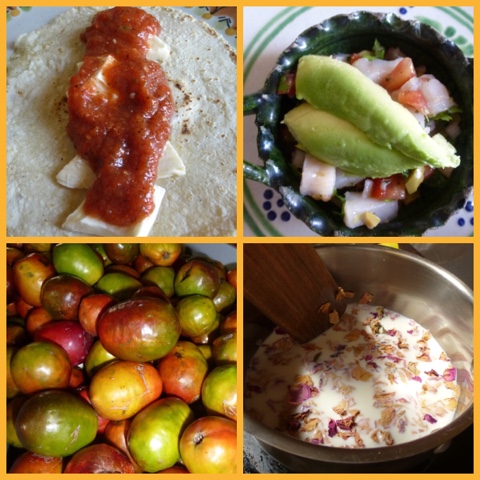
Also three kinds of basic tomato salsa, well one salsa with two additions to make different flavours: cumin and avocado leaves. The latter was my favourite and I'm going to have to try to bring some dried ones home.

The first course was the plain tortillas with quesillo, the Oaxacan string cheese, and my salsas.

Tortillas con quesilla y salsa, ceviche, the local plums, and making rose petal ice cream. 

I had also opted to make ceviche, since I never have, so we made a version that was simply white fish (I didn't ask what kind) along with pickled chiles, olives, capers, onions, and tomatoes. Topped with a few slices of avocado it was totally spectacular.

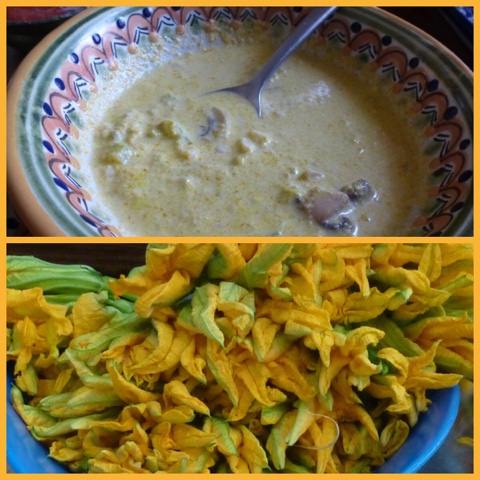
Luckily that course was quite light because the squash blossom soup was rich, rich, rich.  We used an ear of corn, tons of squash blossoms, mushrooms, and a little squash with some onion, a fair amount of milk and a bit of cream but the thick double-cream type cream.  What I really noticed was when sauteeing everything in butter that it smelled very sweet. I took a small taste of the fresh butter and it was like nothing I've ever tasted before. Fresh, sweet, creamy but with a particular flavour that I suppose is due entirely to the cows and the terrain from which it comes. 

Squash blossoms (flores de calabaza) that became a rich soup.

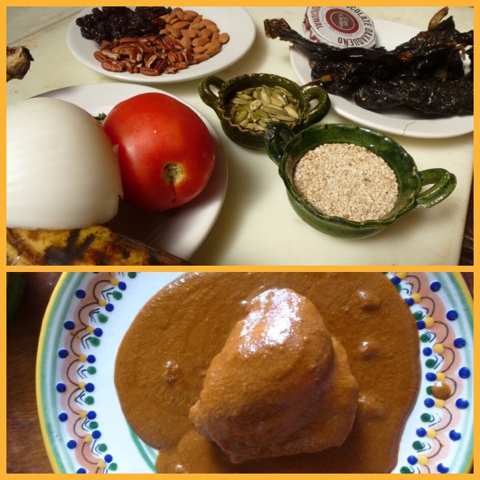
The main course I chose was not one of the seven "official moles" of Oaxaca but one the chef called mole de fiesta, obviously served for holidays and festivals and the one he said he would be making in the restaurant next week for Day of the Dead. It had many ingredients: onions, tomatoes, pecans, almonds, raisins, guajillo and ancho chiles, plantain, oregano, chocolate, allspice, garlic, and cloves. Unlike many that I've made, this mole starts with frying most of the ingredients in oil (rather than dry roasting). It makes it very rich. I'm sure given more time to sit around the flavours would deepen dramatically but even after the short hour of cooking it had, it was really quite amazing. I had it served with poached chicken.

The ingreadients for mole de fiesta and the final product. 
Then last but not least on this eating fest, we made ice cream and since I'd never had it decided to go with rose petal ice cream rather than Oaxacan chocolate. It was also a taste sensation but probably one of those things that you'll either really like or dislike. Again, the bonus of being the only one in the class was I didn't have to worry about whether anyone else wanted to do it.

I, of course, got to eat this giant feast after I made it, sitting solo in the chocolate room in the restaurant. We didn't make anything too crazy: ant mole or worm tacos (they are on the menu there) but it was totally worth it and really pleased to have done it.

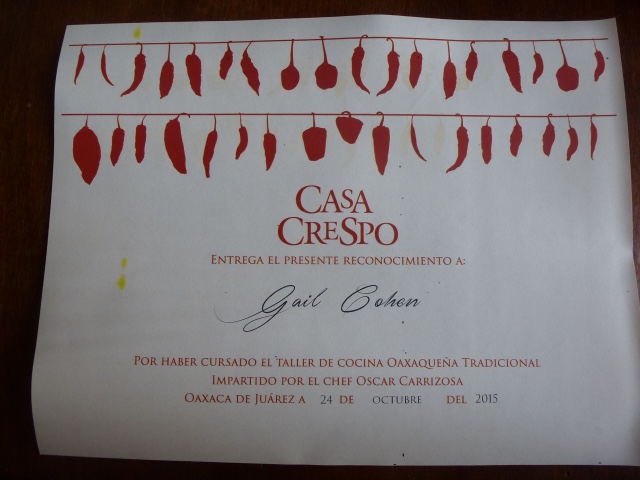
Everyone needs a certificate of conpletion. 


Tuesday, 20 October 2015

Learning Spanish is hard work


 First day at language school was exhausting. When your Spanish is as bad as mine and you have four straight hours of trying not to sound like a total idiot with no grasp of grammar, it can really wear a girl out. It's the constant battle I have of trying to learn new languages but never being as good at then as I am at English and then just getting super frustrated. I'm hoping this three weeks of intensive study will put a bit of a dent in that feeling.

Now that I've seen Oaxaca in the day, I'm much more comfortable and it's got some real gems in it. After class I decided to walk around a bit to get situated but was without the safety blanket of having a map — you know printed on paper like us old folks like. My usual internal compass got a little off kilter with all the rain and the people and the walking through a market but after a slight panic and resorting to Google Maps, I got myself to the zocalo (main square), gave that internal compass a bit of a shake and managed to self navigate back home thus restoring a fair bit of self confidence. But honestly Google is not really doing a particularly stellar job of directing me in Oaxaca so far. 

Finally today I got to delve into some Mexican food. Breakfast was prepared by Carmelita, one of our hosts. A diminutive woman who appears to be an absolute dynamo in the kitchen. A simple omelette with a spicy tomato ksauce was completely out of this world. I wasn't going to have any tortillas with breakfast as I felt I didn't need it and there is going to be no shortage but then one of my housemates didn't want a whole one so I shared it and . . . holy cow batman. I actually thought it was a flour tortilla but no it was corn but ground so fine and with such a different flavour from your run of the mill one. Just wow. 
Pollo en mole negro.

While here, I have the option of eating comida, the main meal of the day, at the house. I am going to do it for the first week while I figure out what's what around town. There's lots I want to eat so don't want to cut out those opportunities eating at 3 every day at home. But that being said, today's lunch was Oaxaca's signature dish: mole negro. The sauce can be made with 30 or more ingredients, including nuts and chocolate. I'm not sure what was in Carmelita's version but it was rich and velvety and served simply over chicken and with rice and tortillas. Another revelation. I'm going to have to get this woman to teach me a few things!

Of course that meant I was pretty full for most of the day but I did have my first Oaxacan hot chocolate and it was superb. I went with the cool kids for a study group at a local cafe and then we wandered about and I snacked on esquites: corn kernels in a cup topped with mayo, queso, chile powder and lime. Muy rico as they say here. A fun night all around.